

We believe the launch of the Specialised Investment Fund (SIF) category in India represents a major investment opportunity for affluent and sophisticated investors seeking access to strategy-rich vehicles under a regulated framework. With the Securities and Exchange Board of India (SEBI) establishing this new asset class effective April 1, 2025, SIFs now offer a bridge between traditional mutual funds and portfolio-management services (PMS), combining transparency with tactical flexibility.
Under the regulatory framework, SIFs are permitted to launch investment strategies in three broad buckets: equity-oriented strategies, debt-oriented strategies and hybrid strategies.
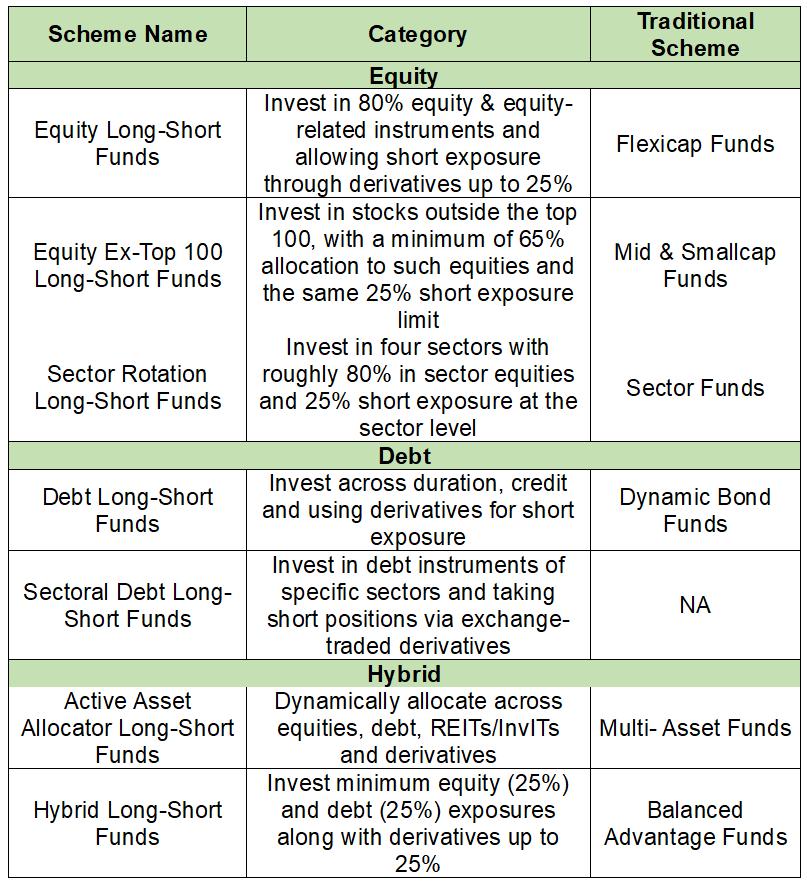
Key features across SIF strategies include a minimum investment threshold of ₹10 lakh per investor (per PAN level across all strategies under the same AMC, unless accredited). AMCs are permitted short exposure up to 25% of net assets through unhedged derivatives, across both equity and debt strategies. Redemption frequency may vary—some strategies may permit daily subscriptions but interval redemptions depending on liquidity.
In terms of live schemes, several fund houses have already launched SIF-branded strategies. For instance, Quant Mutual Fund became one of the first to receive approval for an Equity Long-Short SIF. SBI Mutual Fund launched its “Magnum Hybrid Long-Short Fund” under the SIF structure, offering hybrid exposure across equity, debt, REITs/InvITs and derivatives. Edelweiss Mutual Fund rolled out its Altiva SIF Hybrid Long-Short Fund, targeting the hybrid strategy bucket. Additionally, ITI Mutual Fund has launched “Diviniti SIF” across equity, hybrid and fixed-income SIF strategies.
For investors with the risk appetite and ticket size, SIFs offer the advantage of sophisticated strategy-driven exposure under regulatory oversight and mutual-fund taxation. In contrast with PMS and alternative investment funds (AIFs), SIFs strike a balance of accessibility (₹10 lakh minimum) and strategic flexibility. However, one must recognise that derivative usage, short exposures and narrower liquidity profiles mean higher risk and longer lock-in characteristics. The fund manager’s skill in executing long-short strategies, navigation through market cycles and discipline with hedging will determine success.
In conclusion, we view SIFs as a meaningful addition to the investor’s toolkit. For seasoned investors seeking alpha beyond passive or long-only funds, SIFs represent a timely opportunity—provided suitability, risk understanding and investment horizon are carefully evaluated. There will be a good amount of marketing, however all of these strategies are quite new in approach especially shorting the market is a different skill & there are very few fund managers having the experience, so for majority of investors it would be prudent to wait for their performance for 2-3 years & then plan to invest.
Happy Investing!