

The summer of 2026 has reminded Indians of a new financial reality: climate change is no longer just an environmental issue, it is becoming a household budgeting issue.
Across many parts of the country, temperatures have consistently remained above historical averages. As a result, air conditioners, coolers, and refrigeration systems are running longer than ever before. Families that once paid electricity bills of ₹3,000–₹5,000 per month are now seeing bills touching ₹8,000–₹15,000 during peak summer months.
Ironically, this creates a vicious cycle. As temperatures rise, more air conditioners are installed. Air conditioners release heat into the surrounding environment while consuming large amounts of electricity, much of which is still generated using fossil fuels. The result is increased energy demand, more heat generation, and even higher cooling requirements in the future.
The question many households are asking today is simple: how can we protect our family budget from rising energy costs?
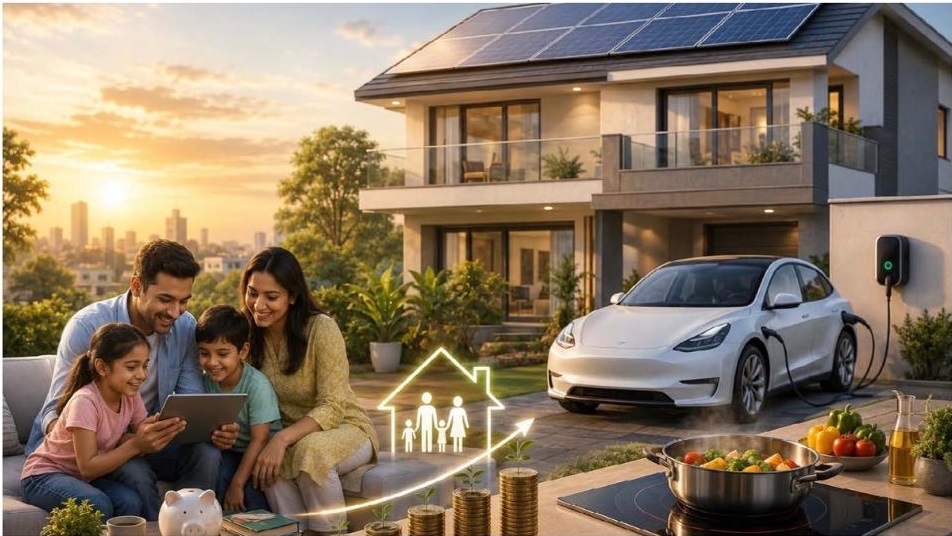
Three solutions are increasingly becoming relevant: rooftop solar, electric vehicles (EVs), and induction cooking.
Consider a middle-class family living in a 3-BHK home consuming around 600-800 units of electricity per month. A rooftop solar system of approximately 5 kW may cost between ₹2.5 lakh and ₹4 lakh after subsidies, depending on location and specifications.
Such a system can generate approximately 550-700 units per month under normal conditions, significantly reducing electricity bills. For many households, the payback period can range between 4 and 7 years, after which the savings continue for another 15-20 years with relatively low maintenance costs.
Electric vehicles offer another opportunity for long-term savings. A petrol car driven 8-900 km monthly can easily consume fuel worth ₹8,000-12,000 per month depending on fuel prices and mileage.
In comparison, charging an EV for the same distance may cost only ₹1,500-3,000 worth of electricity. While EVs currently involve higher upfront costs, lower running and maintenance expenses can result in meaningful savings over the ownership period.
Induction cooking is another underappreciated tool. Traditional LPG cylinders continue to become more expensive over time. Modern induction cooktops are highly energy efficient and can complement existing LPG usage. A quality induction cooktop costs between ₹3,000 and ₹8,000, making it one of the most affordable energy-saving upgrades available.
The larger point is not merely about reducing bills. These investments improve household resilience against future energy inflation.
For example, if a family saves even ₹10,000 per month through a combination of solar power, lower fuel expenses, and efficient electricity usage, that amounts to ₹1.2 lakh annually. Invested systematically, this saving can potentially build a significant corpus over the next decade which can be utilized for such unforeseen expenses.
Energy efficiency is increasingly becoming a financial planning decision, much like insurance or retirement planning.
As India continues to urbanise and temperatures continue to rise, households that proactively adopt energy-efficient technologies may find themselves better prepared for the future. The initial investment may appear substantial, but so did smartphones, internet connections, and air conditioners once upon a time.
The difference today is that these technologies do not just improve convenience—they can actively reduce expenses.